
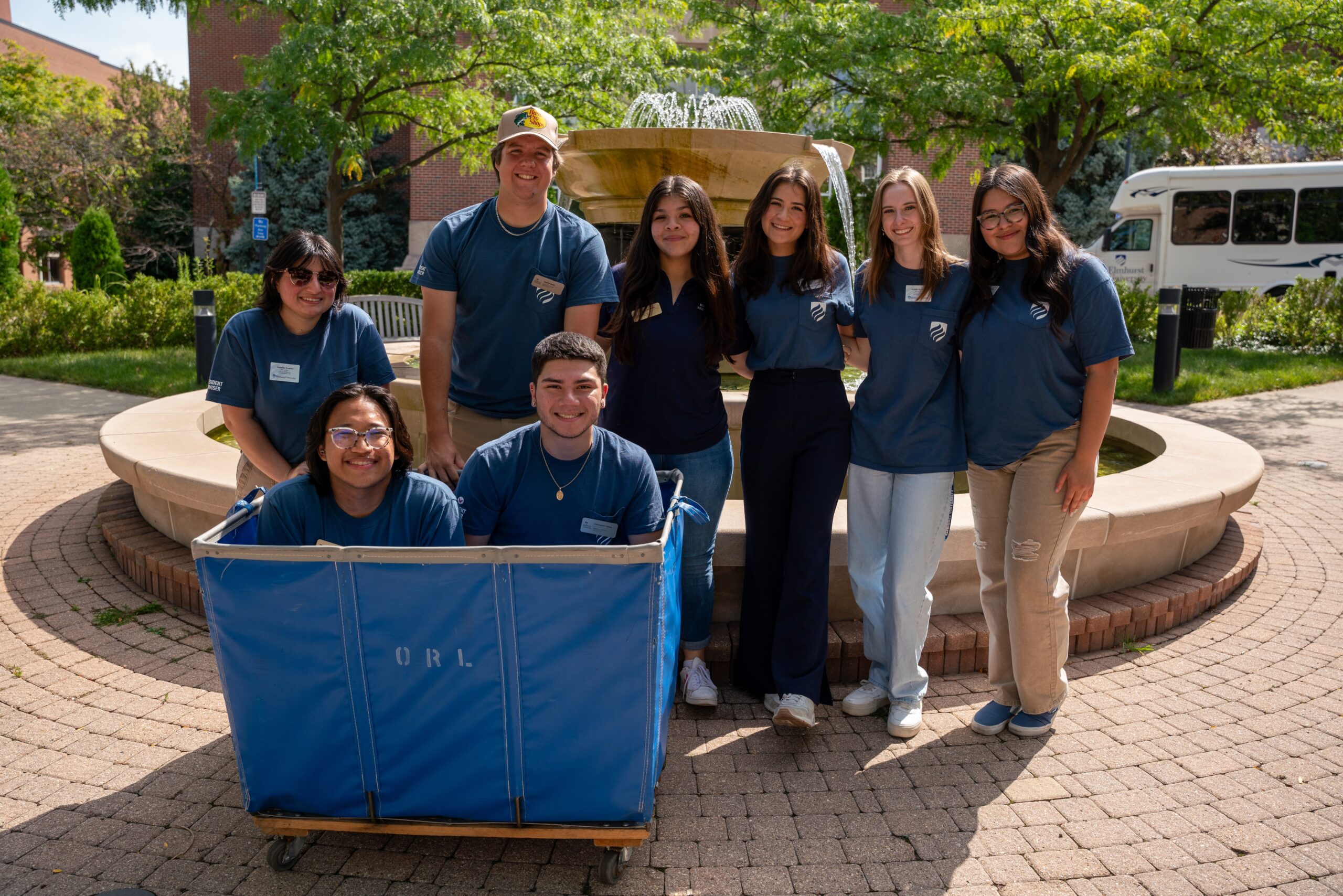
Elmhurst University Ice Scare
Elmhurst, like all private universities, holds the authority to make unopposed decisions that affect its student staff. Sometimes, those decisions touch on questions of free expression, especially in a tense political climate. On September 23, Alejandra Galvan, ’26, faced that tension head-on and she was removed from her position as a head resident by their Office of Residential Life, in a censorship-like fashion.
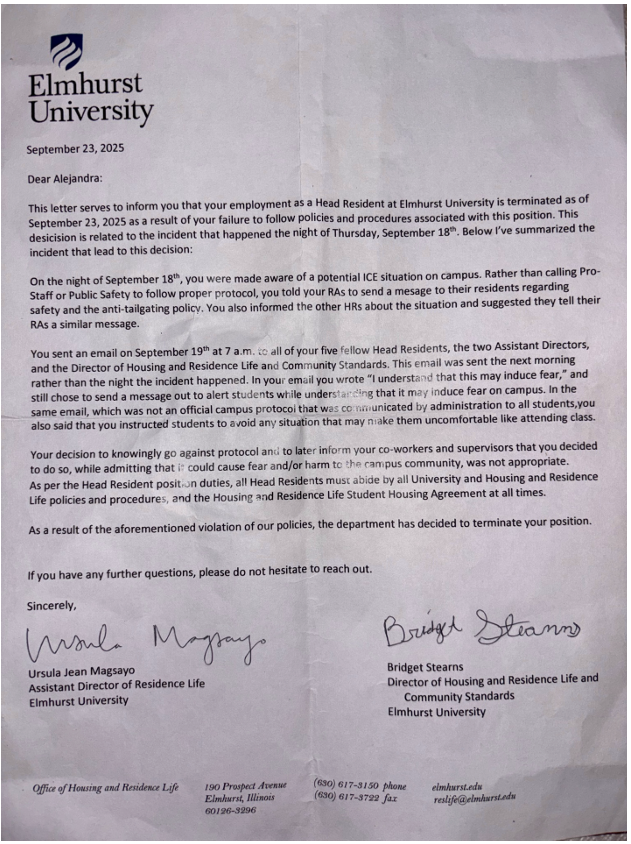
Galvan messaged her team of RAs and HRs to remind residents of the school’s anti-tailgating policies following a reported Immigration and Customs Enforcement concern on campus on Sept. 18. She had been a stellar RA and HR, praised by students and staff for her dedication over two-and-a-half years. However, her termination still came despite everyone else praising her. She was not given an opportunity to appeal.
“I tried to argue the case that I thought it was an unjust termination based on the retaliatory practices section in the Illinois Employment Law handbook,” Galvan said. “It prevents employers from retaliating against employees who engage in protected activities. Given the political climate, ICE targeting not just undocumented individuals but also Black and brown individuals could count as discrimination, which is protected. Even when I was acting to oppose discrimination, I was still fired.”
Elmhurst, like other private employers in Illinois, operates under employment-at-will law, “meaning that an employer or employee may terminate the relationship at any time, without any reason or cause.” Elmhurst’s student newspaper, The Leader, cited her termination as a “failure to follow policies and procedures associated with this position.”
What happened
On the night of Sept. 18, around 11 p.m., a student (who wished to remain anonymous) reported to Niebuhr Hall RA and SGA Vice-President Avaion Viverette that ICE would be on campus the next day. Galvan also confirmed with the student and received the same information. The student also claimed to have shared this with multiple RAs, Elmhurst University’s Office of Public Safety, the Student Government Association, Professor Beatriz Gomez-Acuna, and other offices.
“I have never been notified that ICE agents were on campus,” Gomez-Acuna wrote later, clarifying the report.
Damage Control
At 11:42 p.m., Galvan shared the information she received with other HRs. Around the same time, another RA in Niebuhr Hall suggested highlighting the anti-tailgating policy.
Galvan followed that and suggested the other HR’s have their RAs send messages to their residents reiterating Elmhurst University’s anti-tailgating policy referencing a prior event.
Two weeks earlier Galvan alleged that three male, non-students were in the female resident halls. They began asking the residents questions and attempted opening doors without knocking. When asked how they entered, they claimed a student of Niebuhr gave them her keys to the building but couldn’t identify the resident. The staff then called Public Safety officers who told the men to leave.
“I think a reminder about the Anti-Tailgating Policy was reasonable given this recent incident. If anything, that would’ve provoked more fear since three non-students were knocking on multiple doors and provoking physical fear,” Galvan wrote.
When Public Safety was asked about this incident, they responded: “Elmhurst University is committed to the care, protection and safety of all members of our campus community. Upholding this commitment, under all kinds of circumstances, is vital to maintaining the kind of welcoming, supportive environment where our students can learn, grow and feel that they belong. It includes the development and upholding of policies that protect our students’ safety and security. Subsequently, we cannot comment on personnel matters or potential violations of student policies, including those regarding privacy.”
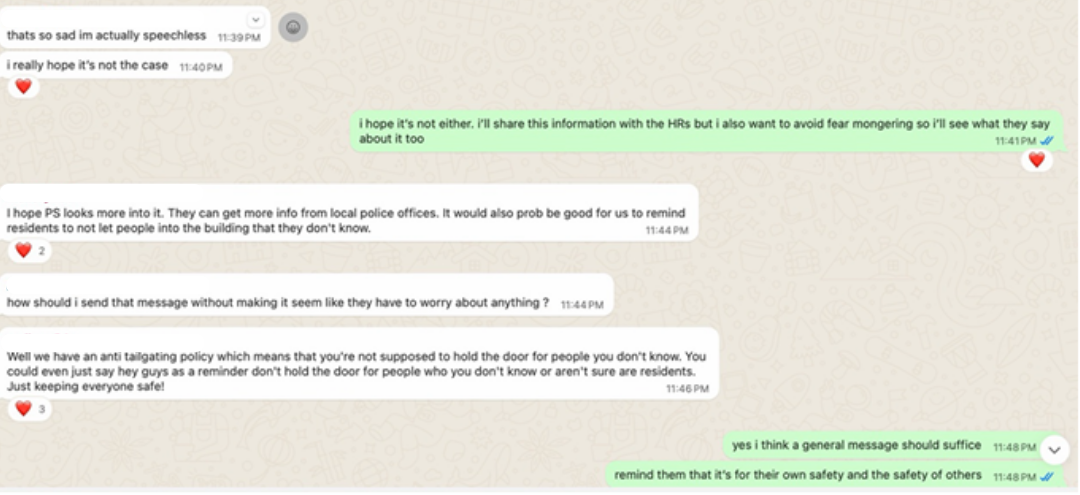
Galvan and other Elmhurst RAs discuss the incident in the Niebuhr group chat.
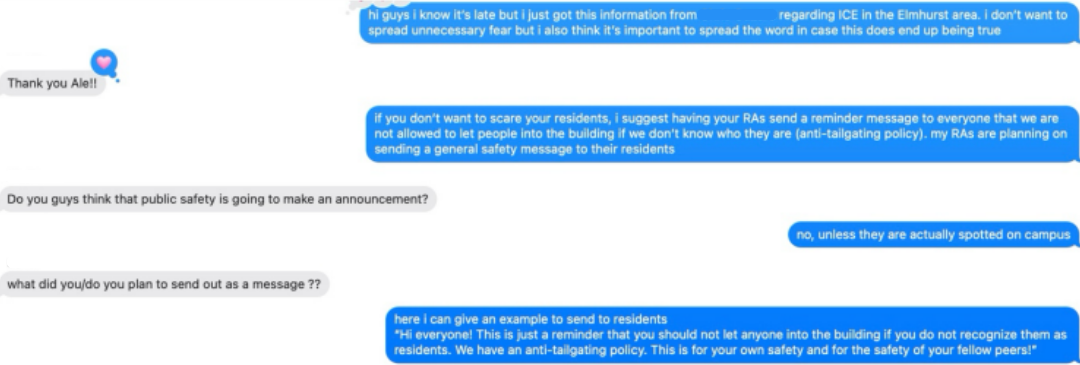
Galvan and other HRs discuss the incident in the HRs group chat.
After Midnight
Yes, one could argue it’s a problem that Galvan had not called any “pro-staff” (supervisors) but she felt this incident did not trigger any of the measures for that policy. The policy states both, “It is always OK to call for help and consult us” and “This list is not all inclusive”. Galvan argued “Since ICE was never explicitly mentioned, this did not violate the sheet.” She then elected to send an email detailing what had happened to the main staff at 7 a.m. the next morning.
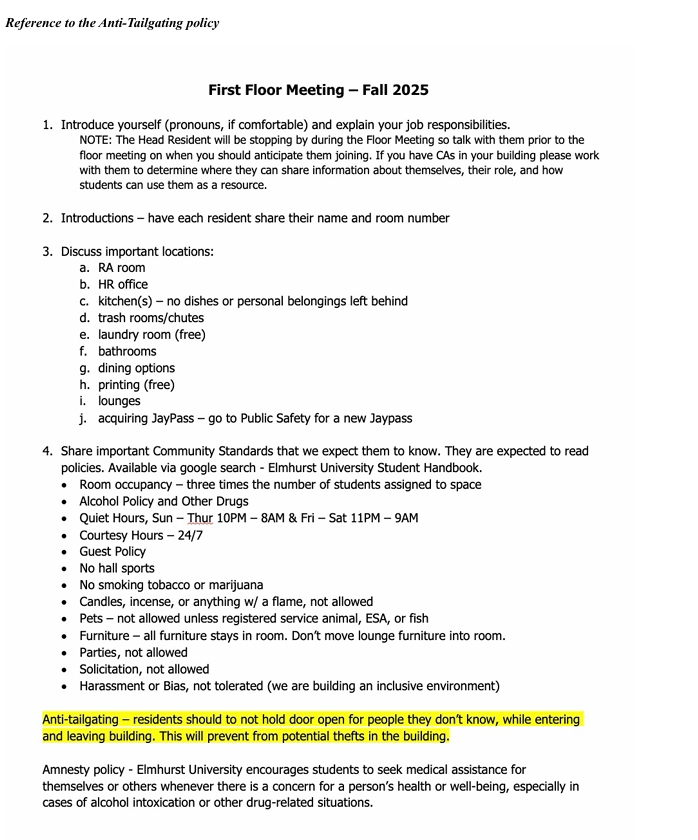
Reference to the Anti-Tailgating policy
Galvan was terminated five days later, on September 23. She created a timeline of events, given to the Chronicle, that she presented to the Elmhurst Dean of Student Affairs.
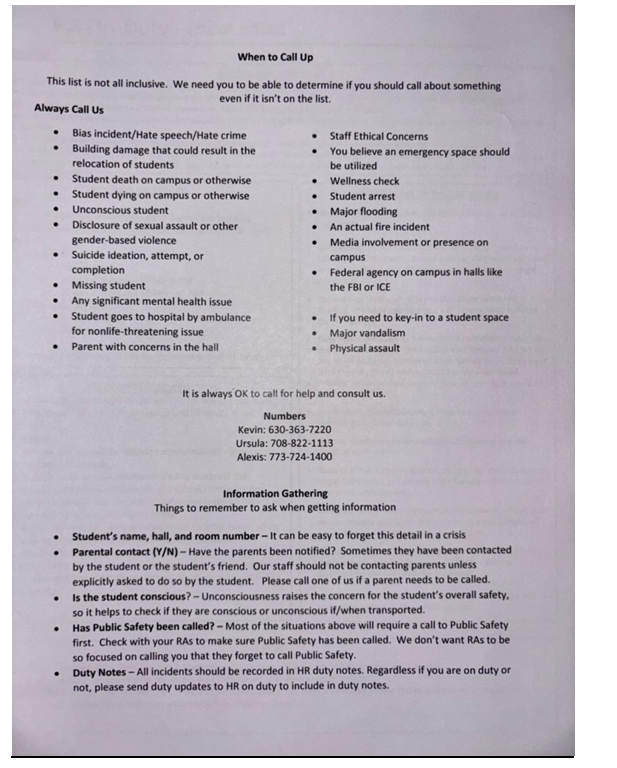
The “When to Call Up” List
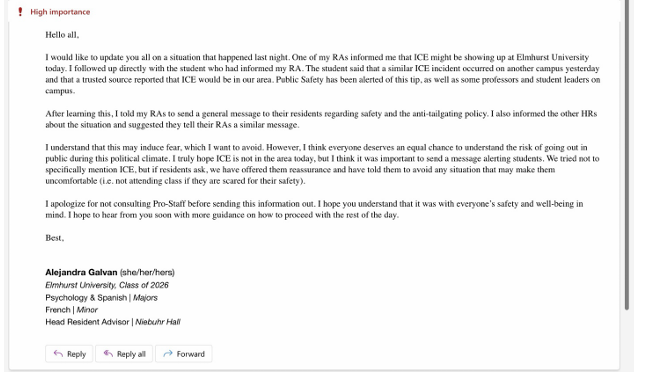
Galvan’s email to the main staff the next morning.
Given the uncertainty of the situation, her actions were reasonable. There was no confirmed ICE activity, and the anonymous student claimed they had already notified the proper authorities. She never suggested the idea, instead, recognized the benefits of that approach. Without the benefit of hindsight, her actions make sense in the context of avoiding fearmongering and protecting students across campus residences.
For this situation, reiterating the anti-tailgating policy was the most prudent course of action to prevent potential escalation. The policy is designed to “prevent potential thefts in the building”, and its application does not endanger residents or disrupt normal operations. By reinforcing the existing rules, with a prior example to reference, she ensured that residents were reminded of safe practices in a way that minimized risk and avoided overreactions.
ICE at NCC and Chicago
Galvan’s situation reflects a larger concern about ICE presence on campuses in the Chicagoland area. After an Elgin Community College incident on Sept. 18, where a student was taken into ICE custody, fears about immigration enforcement spread.
“Something like that happening so close, only could cause fear,” Viverette said.
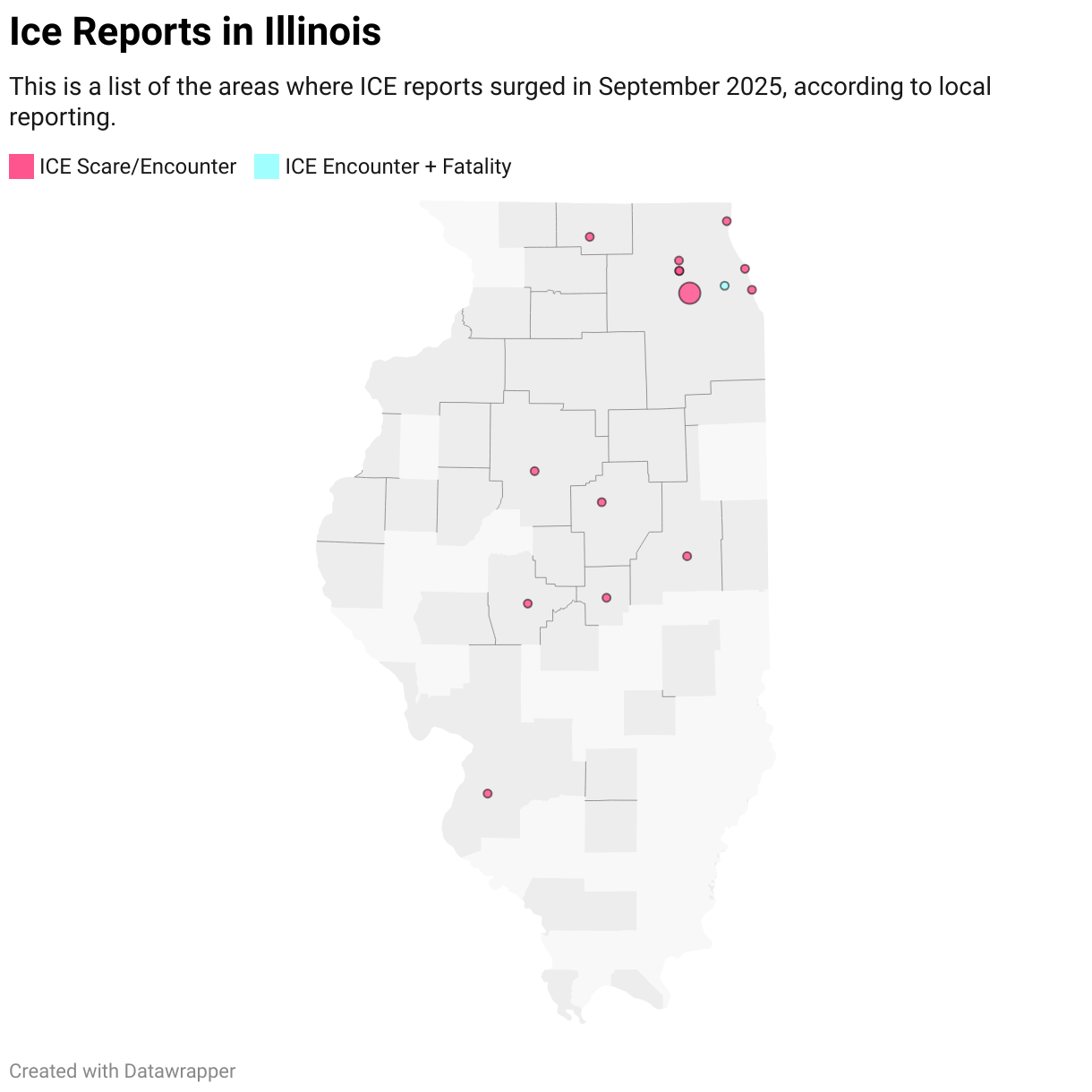
Data visualization of ICE reports in Illinois through September
Recently, Aurora news source, The Voice, claims that ICE abducted two citizens. The Sept. 8 announcement of “Operation Midway Blitz” by the Department of Homeland Security only intensified concerns. This is an ICE operation supposedly honoring Katie Abraham who was killed in a drunk driving hit-and-run car wreck. Organizations like the National Immigrant Justice Center and the ACLU have argued in federal court that ICE has allegedly conducted 27 arrests without warrants or proper cause in Chicago.
NCC also had an ICE scare on Oct. 8. The Office of Institutional Communication quickly addressed the rumors that day via email.
“We are aware of rumors that U.S. Immigration and Customs Enforcement (ICE) agents have been spotted on the North Central College campus. These rumors are unfounded.” The next section of the email states, “Per the College’s protocol: If a member of the campus community observes any law enforcement activity on campus, they should contact Campus Safety immediately by calling 630-637-5911.”
Galvan commented on a similar policy from Elmhurst University.
“So currently our protocol for ICE physically being on campus, is to also just call public safety. That is the only thing that we are told to do. However, there’s no information on what to do between the time that you call and they get here. So, if ICE starts becoming violent with the individual, what are you supposed to do?” Galvan continued, “Even then, a lot of people don’t feel comfortable with any form of authority. So, if they see public safety on top of ICE like that is a new can of worms that you’re opening for this student to feel even more uncomfortable.”
Final notes
Galvan and her community are shaken up by her firing and the political climate.
“I’ve known Alejandra Galvan for 4 years,” Professor Gomez-Acuna wrote. “She is a remarkable student with an impeccable academic record and a strong leadership presence on campus. She’s active in numerous student organizations, honor societies and orchestras. Alejandra is one of the best students we have in the Spanish program. She’s an asset to the university.”
There’s a fine line between promoting safety and censoring students, and sadly, Galvan’s case could have been anyone at any college. All college paraprofessionals need more training and access to resources for their students. Also, in cases like these, someone in power must be held accountable when those same students lose their jobs unjustly.
“This was a position that was really good for me financially, and to lose my job, without a warning, without anything was really unexpected.” Galvan concluded, “Now other Elmhurst RAs have to think about their own financial security before speaking up about something because they feel like they’re going to be fired and silenced in that way, and nobody deserves to feel that way because that is censorship.”
Elmhurst University’s Office of Residential Life, through the Office of Marketing and Communications, declined to comment on personnel matters.
