

Nana Kawasaki is a junior communications major at NCC. She is also an international student from Japan and decided to travel to the U.S. to go to college.
Her first choice at a major was computer science, but it was not offered in Japan. Since she had to look elsewhere, she thought the best place for her would be a big city. However, school wasn’t the only thing on her mind when choosing a location. She also enjoys theater and music.
“Chicago, New York or a big city would be best. I was researching music and singing. Chicago is popular for musicals as well,” Kawasaki said.
Nana’s choice to go to school in the U.S. was also affected by the fact that she would be able to change her major when she wanted to. Japanese universities have a more rigorous course of study that doesn’t allow for much room to change your career path. It also focuses more on classwork than homework.
Japanese vs. American schools
“In Japan, once you get into university, you cannot change your major,” Kawasaki said. “Here there are fewer classes and more homework. There we attend 10 to 15 classes per semester and not as much homework.”
She was excited to meet new people and experience new cultures before she moved to the U.S.
“I wanted to improve my communication skills,” Kawasaki said. “There are so many new things that it is kind of overwhelming.”
Japanese family and friends
Her community in Japan was in full support of her decision to go to NCC. This includes her family and friends.
“My family is living in Singapore right now. They encouraged me to go out a lot, and their thinking is focused on the big perspective. They are supportive of what I want to try,” Kawasaki said.
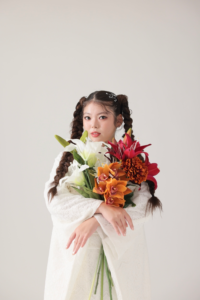
Nana poses for a professional photo with flowers.
Her friends told her she was brave for choosing to go to school in the U.S.
“A lot of Japanese people can’t speak English. They said I am adventurous,” Kawasaki said. “They have respect for what I am doing.”
Overcoming fear
Not everything was perfect. Nana had worries about moving to a new country. She had to make life decisions by herself that she would normally consult her family about.
“I am coming here by myself. Not with my family. And, I have to think about my career first,” Kawasaki said. “If I want to reach out to them, I have to remember there is a time difference. I can barely reach out to them, so I have to figure out everything by myself.”
Nana has to consider her identity much more than when she was in Japan because of the diverse cultures in the U.S. She says she thought her accent would be a barrier to communication but realized that it was not an issue when she started talking with people.
“I have never thought about these things because in Japan, I would say 90% of people are fully Japanese. It is not a diverse country because it is a little island,” Kawasaki said.
Advocating for international students
She likes to set up events for international students to connect with other cultures to help them feel like they are not alone.
“I was the International Student Ambassador in my school. I enjoyed connecting students to international students and helping them communicate,” Kawasaki said.
Her worries were alleviated when she began to speak to other students.
“I was happy to hear that when I tell students I am from Japan, they get excited and want to know about my country.”
Nana’s decision has allowed her to make special connections and share her culture with others. Those same connections have made NCC the perfect fit for her future, despite being far from home.
