

Recently, North Central College students have been unsettled by a string of harassment reports involving an unidentified, non-affiliated individual. They are commonly dubbed by the student body as the “Campus Creep.”
While official descriptions remained vague, he was often being seen primarily along the sidewalks of Brainard Street and Jefferson Avenue. The man persistently approached female students with unwanted propositions to marry him or be his girlfriend. These frequent interactions sparked a wave of anxiety across campus and highlighted a complicated jurisdictional conundrum. When an active threat operates on the literal edges of campus, what restricts Campus Safety? What institutional support can the college actually provide?
Student concerns
North Central College’s Campus Safety announcements were met with frustration, especially on social media sites such as Fizz. Students aired their grievances and questioned whether the administration was doing enough to address these encounters.
One post with 773 upvotes read, “Campus Safety needs to do something before this escalates.” Another user criticized the apparent disparity between the enforcement of parking regulations and the response to the harasser. The post received 571 upvotes.

A post made on Fizz, a school associated social site. (Photo taken by Andy Beltran)
This criticism reflects a growing concern among students who feel that warnings and precautionary advice alone are not enough. Campus Safety emphasized in its official announcement that the department was unaware of specific threats with the reported encounters. They cautioned that the notice did not necessarily indicate a crime had occurred. This distinction matters as it poses a central challenge. What students may perceive as something that requires immediate intervention may not automatically provide authorities with the legal grounds for detention or removal.
Tatiana Tarasoff
While the recent incidents near Brainard Street have not escalated to physical violence, the bureaucratic paralysis echoes a dark precedent in higher education. The issues revolving around the limitations of Campus Safety date back to 1969, when college student Tatiana Tarasoff was murdered by a distressed peer after campus authorities, limited by their own jurisdiction and seeing no legal avenue to detain him, released the perpetrator.
It was a systemic failure where neither police, campus safety, nor health professionals effectively communicated the impending threat to the victim. Following the tragedy, the legal mandates of “duty to warn” and “duty to protect” were put in place across the country. Yet, over 50 years later, the North Central College community is discovering that when a threat operates in the margins between municipal police and campus safety, the institution can still be functionally absolved of liability, leaving students with the sentiment that they must fend for themselves.
Campus safety response
In an email to The Chronicle, Interim Director of Campus Safety Kris Schrubbe confirmed that the individual “voluntarily moved out of his off-campus residence on November 1,” adding that neither Campus Safety nor the Naperville Police Department was involved in his departure.
When asked in a follow-up about Campus Safety’s legal limits regarding no-trespass warnings and whether new protocols are being developed for future off-campus incidents, Schrubbe did not address those specific policy questions. Instead, he stated that North Central “maintains a close working relationship with the Naperville Police Department, as well as other emergency service agencies, including the Naperville Fire Department, to provide comprehensive safety resources” both on campus and on adjacent property.
Schrubbe advised that any student who feels unsafe or threatened, “regardless of their specific location,” should call 9-1-1. He added that Campus Safety remains available through its 24/7 hotline (630-637-5911) and campuswide emergency call boxes, noting that officers are trained to “assess emergency and non-emergency situations, and make determinations as to when to engage its emergency service partners”.
Title IX
As questions regarding Campus Safety’s operational authority remain, Title IX Coordinator Kristin Jones offers insight into the college’s disciplinary limitations. Especially regarding individuals unaffiliated with the institution.
“There’s not a lot we can do, right? We can’t do a formal Title IX case when it’s just a community member walking through our campus,” Jones explained.
According to Jones, The individual is not someone affiliated with North Central College. This means a Title IX disciplinary process could not be enacted against him.
Student safety
However, the college is not entirely powerless when it comes to supporting victims. While a formal Title IX investigation was off the table, Jones clarified that her office can implement immediate supportive measures. These include safety planning, campus escorts, flexibility with housing and instructors, and acting as a liaison with the Naperville Police Department for students wishing to file a municipal report. The college’s published Title IX and Sexual Misconduct Policy also identifies circumstances in which no-contact or no-trespass orders may be implemented against unaffiliated third parties. Whether such measures were considered or applicable in this particular case remains unclear.
“We definitely don’t want students falling into any gaps in terms of jurisdiction,” Jones said.
Jones described the incident as the first involving a comparable off-campus individual during her tenure. Although, she had encountered similar situations at other institutions.
Examining beyond the immediate controversy, Jones emphasized the importance of educating individuals about bodily autonomy, personal boundaries, and appropriate conduct from an early age. She compared this construct to the widespread adoption of seatbelt use. Preventing harassment requires long-term changes in social attitudes.
Jones also encouraged students to practice bystander intervention through strategies such as distraction, delegation, direct intervention when safe, and delayed assistance.
What happens next?
Perhaps the most important takeaway from these incidents is the need to remain vigilant and recognize that student safety extends beyond the responsibilities of Title IX and Campus Safety alone. While the college has encouraged precautionary measures, whether additional protective protocols will emerge from these events remains unclear.
Yet amid the concerns surrounding institutional authority and accountability, Jones emphasized what she believes defines North Central College.
“My hope is that your readers are feeling that this is a community of care. They care for one another,” Jones said.
While Jones’ words reflect the institution’s stated commitment to the well-being of its students. However, the true measure of that commitment extends beyond reassurance. It lies in how effectively the college prepares for future incidents. How it addresses the limitations of its authority and ensures that students are not left navigating those boundaries alone. The “Campus Creep” may have departed to his own volition, yet questions surrounding institutional preparedness remain. A community of care is defined not merely by its response to a crisis. It is by the measures it takes before the next one begins.
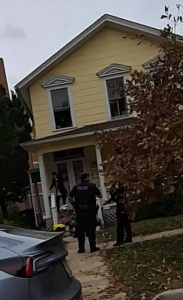
The police confronting the harasser at his home. (Photo taken by Fizz user)
